Art Nouveau Architecture in Paris: The Romance of the Belle Époque
Though Paris is mainly known for its wide, tree-lined Haussmannian boulevards and Gothic icons like the Notre Dame, there’s an unsung style of architecture that’s quietly defined the City of Light since the late 19th century: Art Nouveau.
A rebellion against the industrial revolution and aforementioned uniform Haussmann style, Art Nouveau embraced organic shapes, fluid lines and nature-inspired motifs. Though Europe-wide, at the heart of this artistic movement was Paris, where pristine examples of Art Nouveau architecture still remain — and they’re not tucked away in museums, but feature throughout the city from metro stations to building façades.
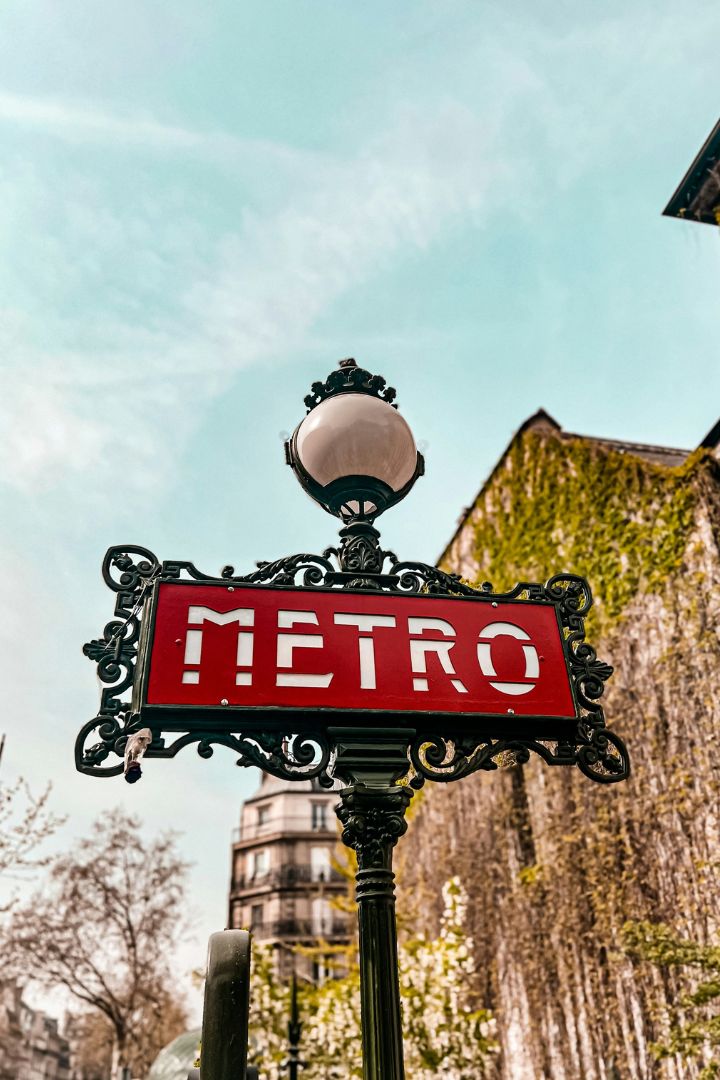

French Art Nouveau architect Hector Guimard designed 380 metro entrance kiosks between 1899 and 1904, but just 86 remain today.
The Art Nouveau movement
Art Nouveau literally translates to ‘new art’ from French, and the movement spanned roughly between 1890 and 1910, emerging in Belgium before spreading throughout western Europe and over to the United States. It was deeply inspired by the British Arts and Crafts movement which began around 1880 (of which William Morris was a key figure), placing an emphasis on floral motifs, craftsmanship and intricate handmade objects. Art Nouveau built on the rustic, functional themes in the Arts and Crafts movement, transforming them into something more refined and modern, using industrial materials while retaining an emphasis on nature.
The Art Nouveau movement coincided with La Belle Époque (‘The Beautiful Era’), a time of prosperity between 1871 and 1914 for Paris’ middle and upper classes – including artists and architects. It allowed these designers to become more flamboyant with their designs, take risks and flourish.
Named in retrospect, the Belle Époque was the calm period between the end of the Napoleonic wars and beginning of World War I, when both Art Nouveau and Belle Époque came to an end. The war brought about a more functional approach to art and architecture, and countries couldn’t afford the ornate designs and costly materials (like iron) associated with Art Nouveau. After World War I, Art Deco replaced Art Nouveau with its more efficient, geometric aesthetic.
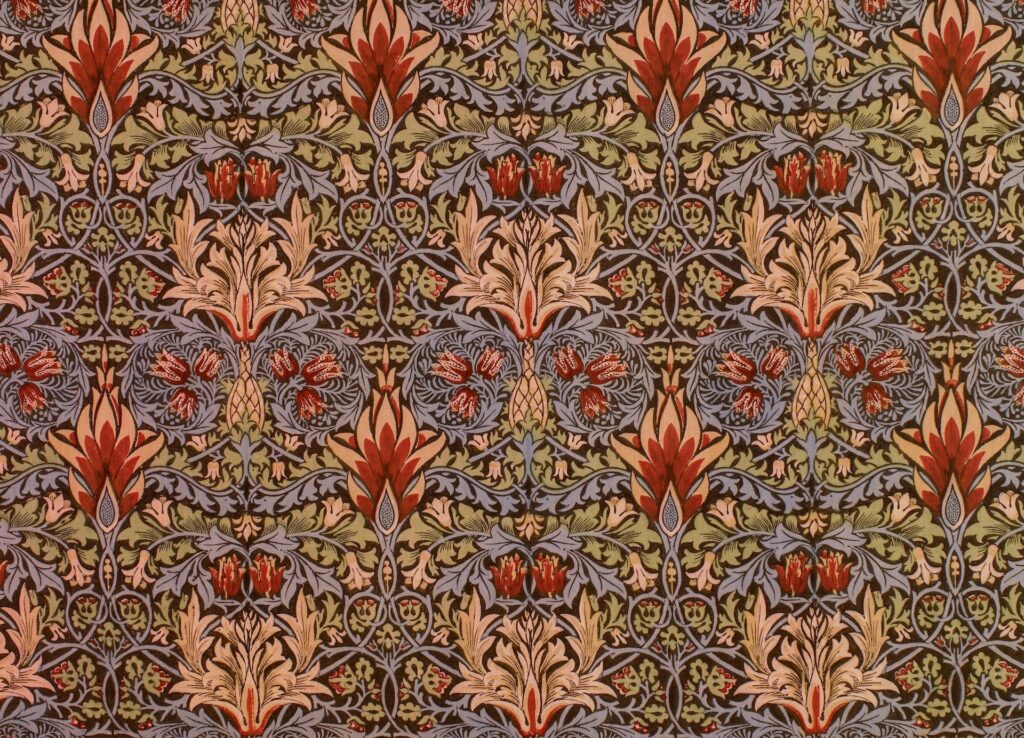
William Morris Snakeshead 1876 design
What is Art Nouveau Architecture?
If Art Nouveau symoblized artistic freedom and creative expression with sinuous lines (known as ‘whiplash‘), it was a feat of engineering that Art Nouveau architecture managed to embody these themes using materials like iron, steel and glass.
Victor Horta was a Belgian architect and designer, and widely regarded as the pioneer of the Art Nouveau movement. He designed Hôtel Tassel in Brussels, which is often considered the first Art Nouveau house and was incredibly radical at the time, built for the scientist and professor Emile Tassel between 1892–93. Horta didn’t draw a line between function and decoration, but blended the two.
Bannisters become twisted tendrils, balustrades are formed of vines, and iron flowers adorn glass chandeliers. Symmetry is a rarity in Art Nouveau architecture, with one swooping, circling line often dividing facades, doors or windows into sections. Nature-inspired shapes are front and center, as is plenty of natural light through large windows or skylights, often made with stained glass.
Hector Guimard
After meeting in Belgium in 1894, Horta became an inspiration for Hector Guimard, France’s leading Art Nouveau architect and designer. Back in Paris Guimard built 50 buildings between 1890 and 1930, which led to the French capital becoming the international epicenter of Art Nouveau.
In 1887 Gustav Eiffel had pioneered the use of exposed metal, but Guimard (and Horta) expanded the use of this material in both functional and decorative ways, from interior and exterior pillars to beams, banisters and grilles, forming curved, organic shapes and structures.
Guimard’s metalwork is best appreciated in the entrance arches he designed for the Paris Métro. After the success of his first design, Castel Beranger (read more on that below), Guimard won the city council commission for the design of the underground metro system, designing 380 entrance kiosks between 1899 and 1904.
Though Guimard’s work and contributions to art and architecture are widely appreciated today, Parisians weren’t so fond of them at the time — in fact, Parisians weren’t enamoured with Art Nouveau in general. Guimard’s designs were considered too extravagant, the green cast iron was too dark, and the font was criticized as being too hard to read.
After World War I ended and Art Deco began to take over art and architecture, evidence of Guimard’s designs slowly diminished, his work demolished throughout the city. Sadly, by the time Guimard died in 1942 his work was largely forgotten in France. It was only in 1970 with an exhibition in New York that a revival and appreciation of his work began.
Save up to $3,000* per couple on your first Premium Tour
Plus receive latest offers, travel inspiration, and discover how your travels will make a positive impact. Together, WE MAKE TRAVEL MATTER®. Subscribe NowOther Art Nouveau figures
Alongside Guimard there are a other key figures associated with the movement from across Europe. One of the most well-known is Alphonse Mucha, a Czech artist who defined the Art Nouveau movement with his distinctive posters often featuring ethereal women with long flowing hair, intricate floral motifs and soft pastel color schemes.
Meanwhile, over in Britain the Scottish architect and designer Charles Rennie Mackintosh was pioneering a unique form of Art Nouveau that’s now referred to as the ‘Glasgow Style’, which focused more on geometric forms and subtle nods to nature. This stylr was led by the ‘Glasgow Four’, made up of Mackintosh alongside Margaret Macdonald, Frances Macdonald and Herbert MacNair.
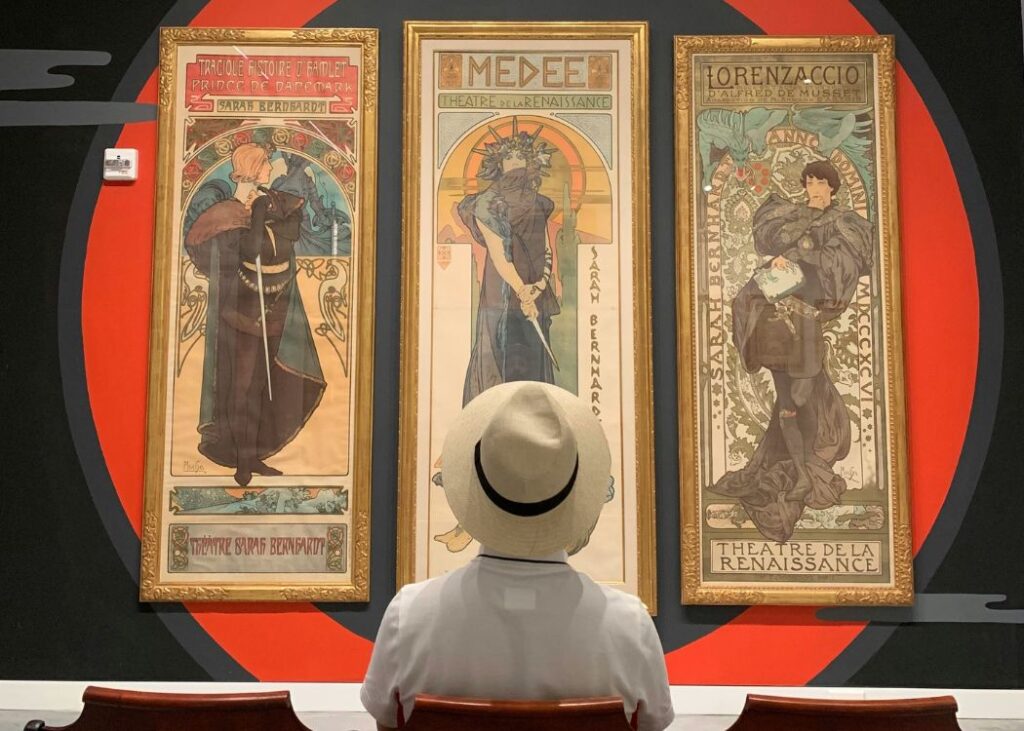
Alphonse Mucha’s posters exhibited at Poster House in New York
The posters and paintings that defined Art Nouveau in Paris were created by Henri de Toulouse-Lautrec, whose style combined bold colors, sinuous lines and Japanese-inspired compositions that captured the bohemian nightlight of late 1800s Montmartre. The Moulin Rouge is one of the defining symbols of the hedonistic Belle Époque era, and Toulouse-Lautrec famously immortalized the theater in his work.
Georges Fouquet was a French jewelry designer who featured his Art Nouveau designs at the Exposition Universelle in Paris in 1900 — his collaboration with Alphonse Mucha was prominently showcased, an intricate collection of jewelry featuring natural motifs and the use of materials like ivory, mother-of-pearl and gemstones. It quickly became an iconic representation of the Art Nouveau style.
Iconic Art Nouveau buildings in Paris
Porte Dauphine
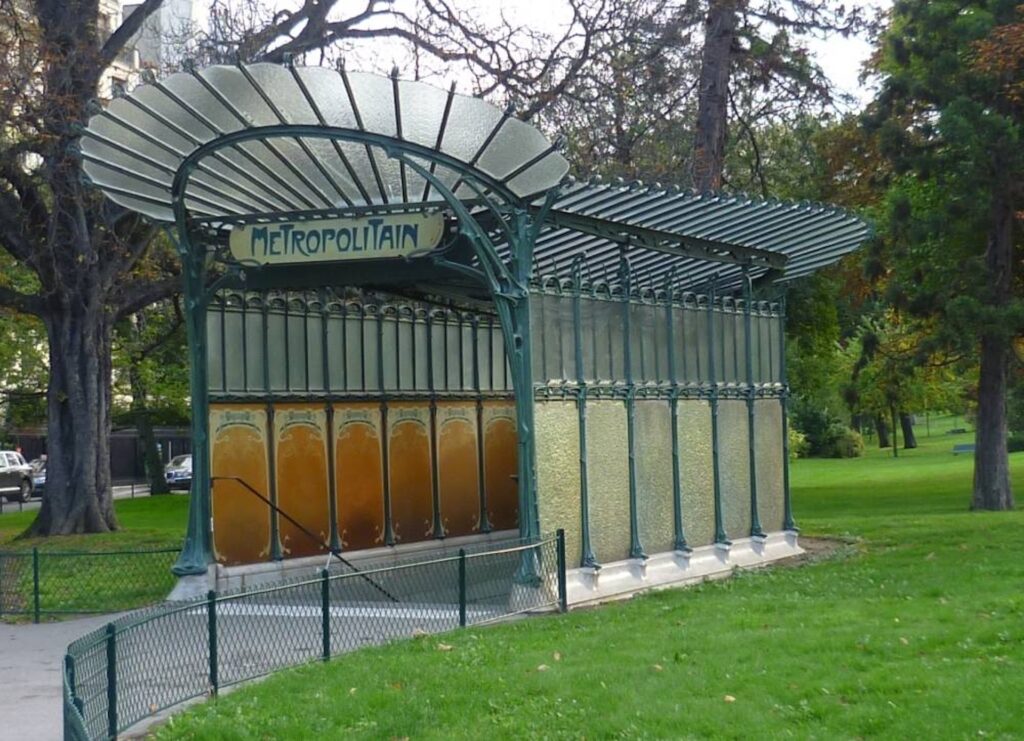
Image credit: Jacqueline Banerjee
Hector Guimard designed 380 metro entrance kiosks between 1899 and 1904, but just 86 remain today. One of the finest examples is Porte Dauphine, opened in 1900 east of Bois de Boulogne park and restored in 1999. The only surviving metro station of its style (Guimard had three distinct designs for the station entrances),it’s nicknamed the ‘dragonfly’ because of its glass roof and cast iron structure, giving it a winged look. Porte Dauphine is the only metro entry of its kind that’s not reconstructed or relocated from elsewhere.
The Lavirotte Building
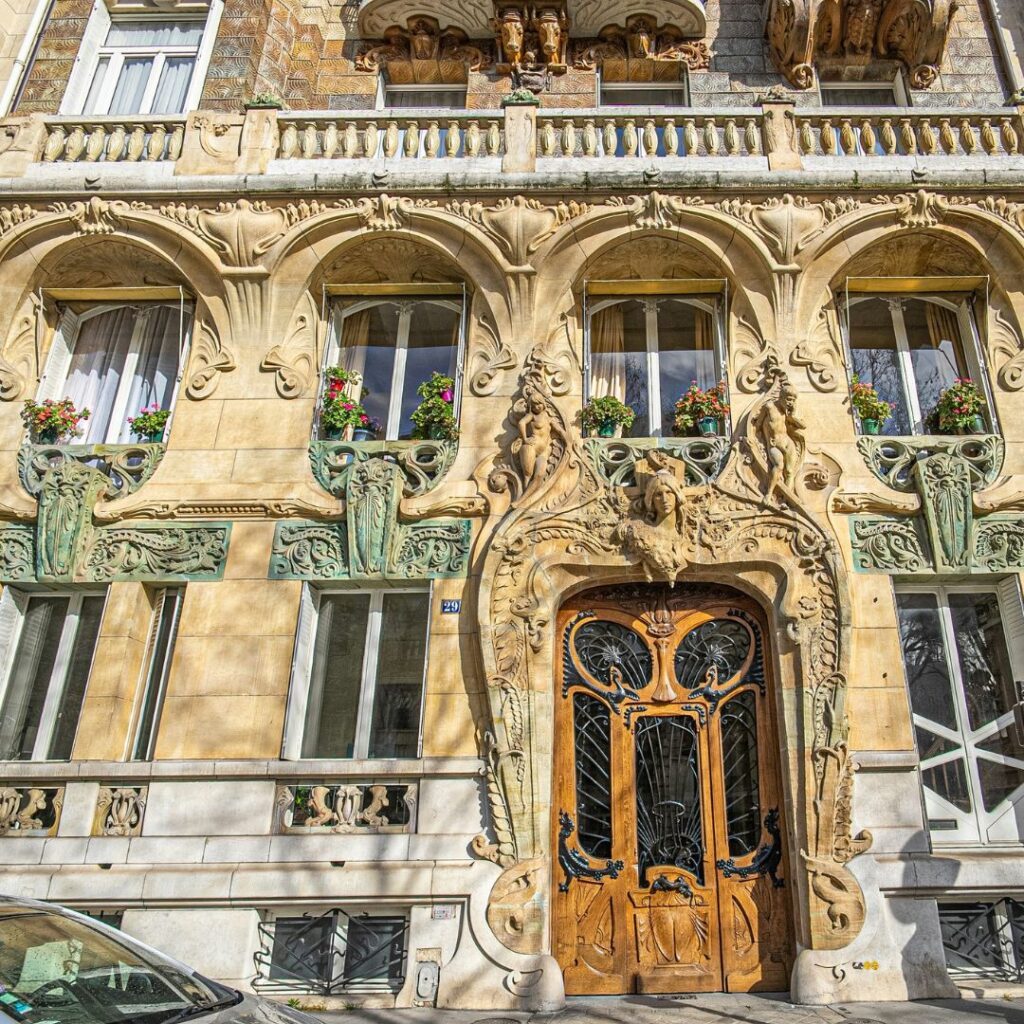
While Guimard often dominates conversations around Parisian Art Nouveau architecture, French architect Jules Lavirotte also made significant contributions to the movement. Many of his buildings are found in the 7th arrondissement in Paris, and one of the best examples of his work is the Lavirotte Building an apartment building at 29 Avenue Rapp. The façade was erected in 1901 and won the annual architectural frontage competition of Paris that year. Its entryway depicting the Garden of Eden is an absolute feast for the senses, from depictions of a seductive Eve to a smorgasbord of animals including peacocks, reptiles and bulls alongside a bronze lizard as the entrance handle.
Grand Palais
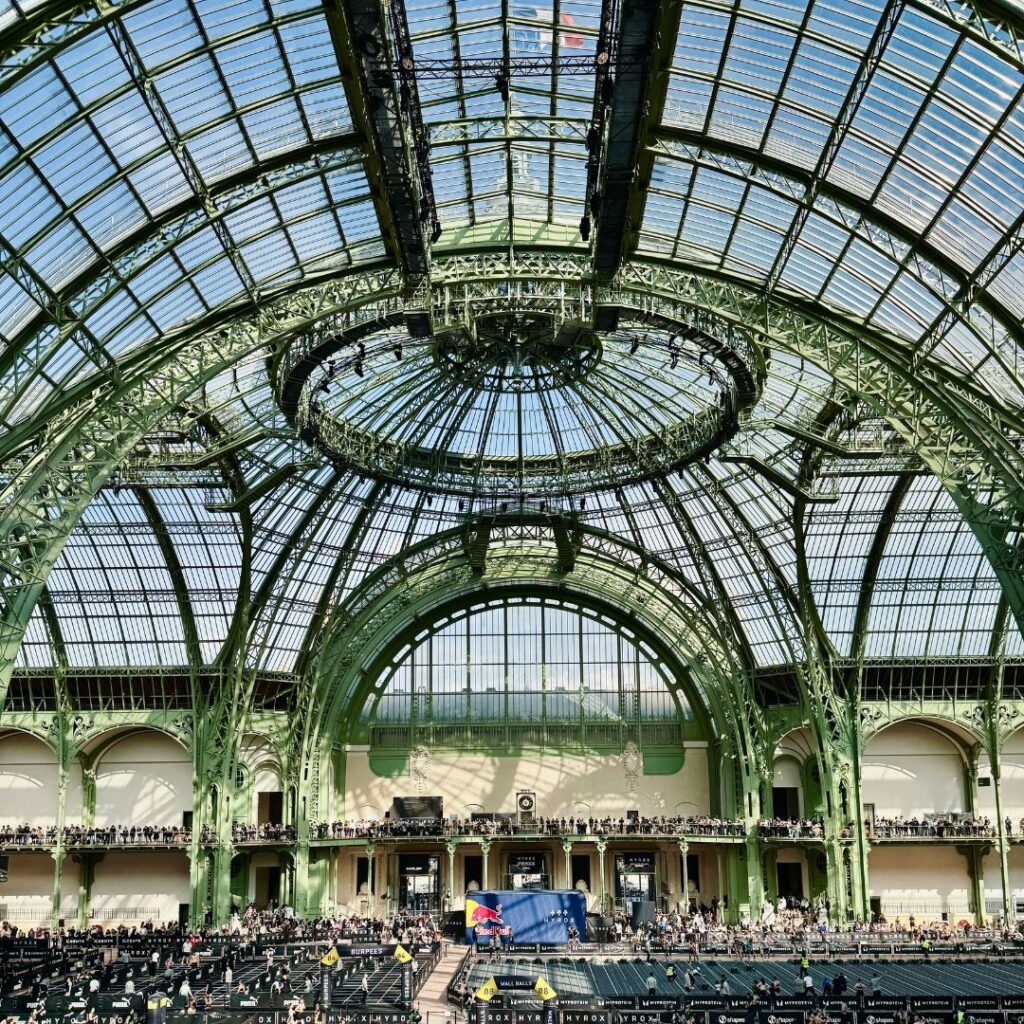
Just a stone’s throw from the Champs-Élysées sits the Grand Palais, an iconic historic site that also doubles as an exhibition hall and museum complex. Like many Art Nouveau icons it was built for the 1900 Universal Exhibition. While much of the building’s exterior is considered neoclassical, its distinctive glass dome features interior ribs and tendrils made out of iron, and the unmistakable “whiplash” of Art Nouveau lines. The roof weighs an impressive 8.5 tonnes, and has been listed as a historic monument since November 2000.
Castel Béranger
Castel Béranger was the first private residence in Paris built in the Art Nouveau style, designed by Guimard when he was just 30 years old and constructed between 1895 and 1898.
Ornate balconies, an asymmetric, flowing door, and rounded entranceways feature throughout the building, using materials including ceramic, glazed sandstone and iron. Various animals like iron seahorses climbing up the façade, and the building gained its nickname ‘Maison du Diable’ (House of the Devil) because of the iron masks that adorn the balcony balustrades. Guimard also had a hand in the interior design including wallpaper, door handles and carpets.
Considered the architect’s seminal work, it won first prize for the most beautiful façade in Paris and is now classified as a Historical Monument. Such was Horta’s effect on Guimard that when his first design was complete, the French architect sent him an album of the designs of the building with the words: “To an eminent master and friend, Victor Horta, affectionate homage from an admirer.”
Pont Alexandre III
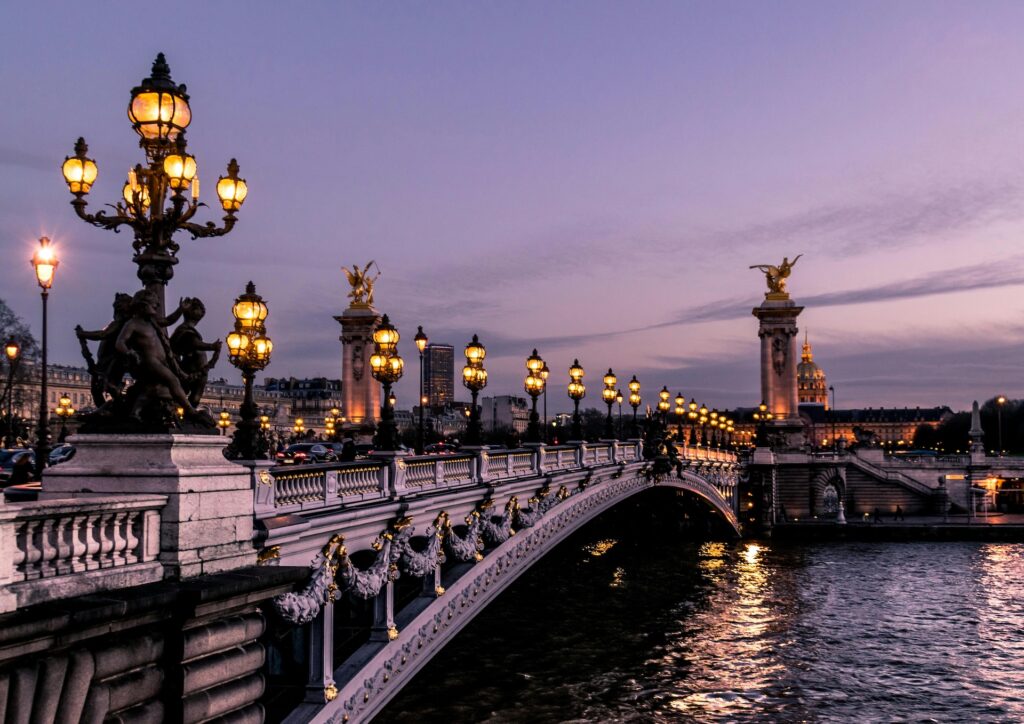
The iconic Pont Alexandre III bridge was built for the 1900 Exposition Universelle, and is now a listed historical monument. The bridge is decorated with cherubs, nymphs and golden Pegasus, but Art Nouveau makes an appearance in the wrought iron lamps which illuminate the bridge once the sun sets.
Galeries Lafayette Haussmann
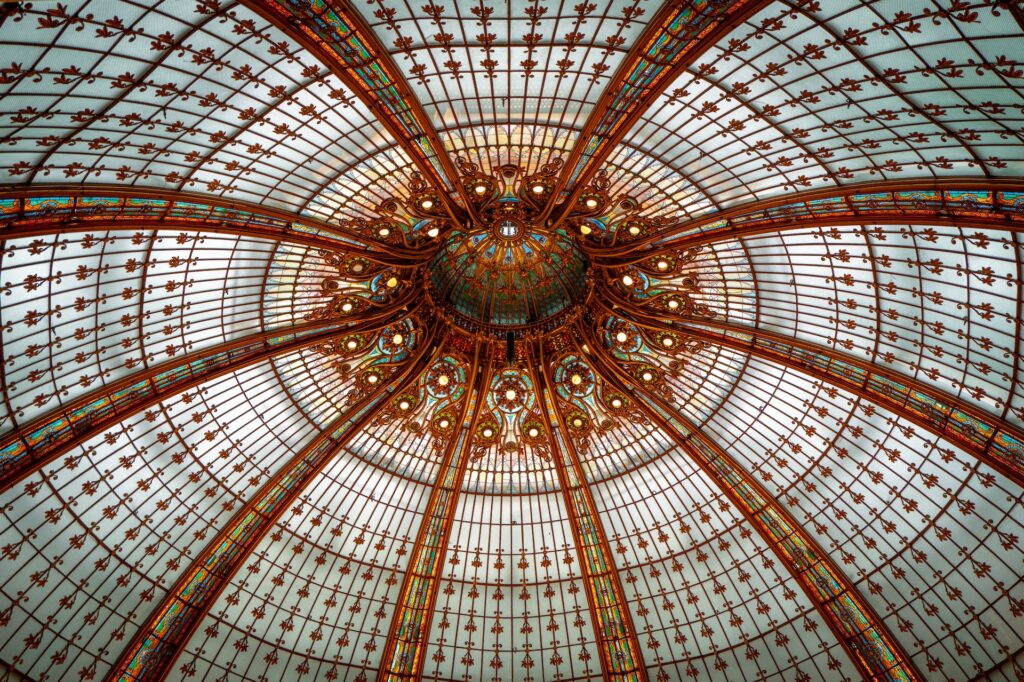
This decadent French department store was founded in 1894, and its grand dome was built in 1912 — and became one of Paris’ Art Nouveau icons. The great hall was designed by Édouard Schenck, Jacques Grüber and Louis Majorelle to bring light into the store. The stained glass forms an immense flower at the center of the dome, stretching over a total of 1000m², with ornate ironwork covering the entire structure. When you enter Galeries Lafayette, don’t forget to look up!
Art Nouveau Architecture Museum
A museum dedicated to celebrating Guimard’s work is in the works. It will be housed in the Hôtel Mezzara, a four-storey building in Paris’s 16th arrondissement which was designed by Guimard himself in 1910. Once open it will display Guimard’s creations including Art Nouveau furniture and decorations as well as an archive of his designs and documents.
The building, originally commissioned by in 1910 by Guimard’s friend Paul Mezzara as his private mansion, will undergo a €6m (£5.2m) two-year renovation, set to open around the end of 2027. As well as the art displayed within, the building is a living example of Guimard’s signature ironwork including a spectacular glass skylight, along with iron banisters and chandeliers.
Discover Parisian Art Nouveau architecture on our premium tours to France.
About Jess Williamson

Jess is an experienced writer and editor, with 6 years' experience working within the whisky industry. Her work has taken her to Scotland and beyond, while her personal travel highlights include backpacking around Vietnam with her sister, trips to California, Madrid, and the Greek islands.
LIKED THIS POST? SHARE WITH YOUR COMMUNITY
Keep exploring